How AI search visibility is reshaping digital marketing and what you need to know to stay visible in 2026
The Shift Nobody Predicted
Nearly 60% of Google searches now end without a single click. That statistic alone should make every digital marketer pause. But the story gets more interesting when you examine where those searchers are actually going.
ChatGPT now has over 800 million weekly active users, up from 400 million in February 2025. Google Gemini has surged to 18% market share, up from just 5.4% a year ago. AI platforms generated over 1.1 billion referral visits in June 2025, up 357% year-over-year.
This is where Search Intelligence AI enters the conversation. Not as a buzzword, but as a practical discipline for understanding how your brand appears when people ask AI platforms for recommendations, comparisons, and advice.
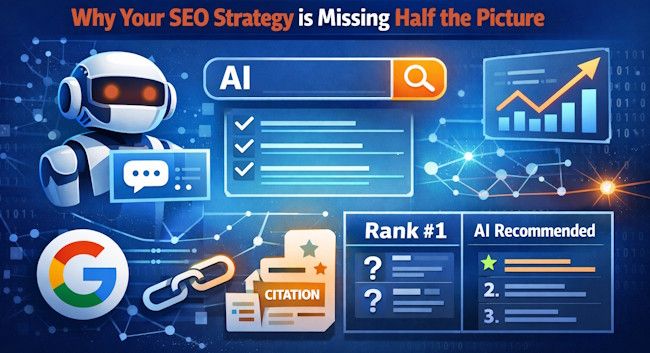
The challenge is straightforward: you can rank number one on Google and still be completely invisible when someone asks ChatGPT.
“What’s the best HTML editor tool?” 👨💼
or when Perplexity generates a comparison of accounting software options.
Traditional SEO metrics tell you where you rank. Search Intelligence AI tells you whether AI actually recommends you.
The Numbers That Changed Everything
Before diving into methodology, let’s examine the data that’s driving this shift. These aren’t projections or estimates. They’re measurements from 2024-2025 that reveal how fundamentally search behaviour has changed.
ChatGPT’s Dominance🤖
ChatGPT commands 68% market share among AI chatbots, according to Similarweb data. The platform receives 6.3 billion monthly web visits and has risen into the world’s top five most-visited websites.
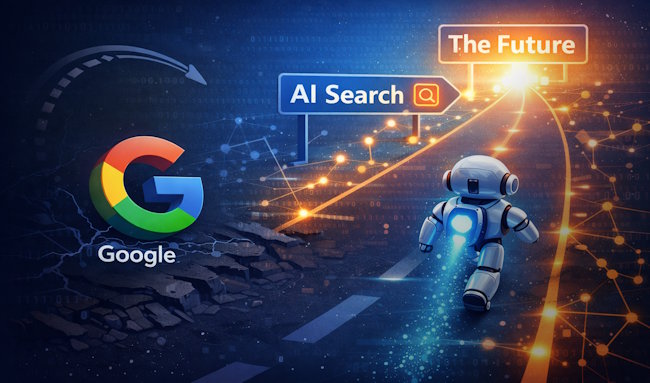
When people ask ChatGPT a question, they’re increasingly treating the response as definitive. They’re not necessarily clicking through to verify. They’re acting on the recommendation directly.
The Zero-Click Reality🖱️
Research from SparkToro and Datos found that 58.5% of US searches and 59.7% of EU searches end in zero clicks. For every 1,000 Google searches in the US, only 360 clicks go to the open web.
As Rand Fishkin wrote:
This creates an uncomfortable truth for traditional SEO: driving rankings doesn’t automatically drive traffic anymore.
AI Overviews Expansion📋
Google’s AI Overviews appeared on between 16-60% of search queries depending on the study methodology and keyword set. Semrush’s analysis of 10 million keywords found AI Overviews triggered on 15.69% of queries in November 2025, while Advanced Web Ranking data found them on over 60% of US searches.

When these overviews appear, organic click-through rates drop by an average of 34.5% according to one study.
The pages that get cited within AI Overviews continue to receive traffic. The pages that don’t see their visibility effectively erased, regardless of their traditional ranking position.
AI Referral Traffic Growth📈
AI-referred sessions increased from 17,076 to 107,100 between January-May 2025 compared to the same period in 2024, representing a 527% year-over-year increase.

Total Gen AI referral visits reached 2 billion in 2025, with a 778% year-over-year increase.
This isn’t incremental growth. It’s a fundamental shift in how people discover and interact with online content.
What is Search Intelligence AI?
Search Intelligence AI refers to the practice of monitoring, measuring, and analysing how brands appear across AI-powered search and assistant platforms. It’s the discipline of understanding your visibility not just in traditional search results, but in the recommendations that AI systems generate.
This includes tracking visibility across:
- ChatGPT: The dominant AI assistant with 68% market share
- Google AI Mode: Google’s integration of generative AI into search results
- Gemini: Google’s standalone AI assistant, now at 18% market share
- Perplexity: The AI-native search engine with 370% year-over-year growth
Search Intelligence AI differs from traditional SEO in several fundamental ways.
Traditional SEO asks: “Where do we rank for this keyword?”
Search Intelligence AI asks:
“When someone asks an AI for a recommendation in our category, do we get mentioned? In what context? With what sentiment? Before or after our competitors?“
The distinction matters because AI platforms don’t simply retrieve and rank pages. They synthesise information from multiple sources, apply their own understanding, and generate responses that may or may not include your brand, regardless of your search rankings.
The Three Pillars of AI Search Visibility
Understanding AI search visibility requires examining three distinct metrics that together paint a complete picture of how your brand appears in AI responses.
Pillar 1: Appearance Rate
Appearance rate measures how frequently your brand is mentioned when AI platforms respond to queries relevant to your industry.
If you sell email marketing software, appearance rate tracks how often AI mentions your brand when users ask questions like:
- “What’s the best email marketing tool for small businesses?”
- “Compare Mailchimp alternatives”
- “How do I choose an email marketing platform?”
A brand might have a 45% appearance rate, meaning they’re mentioned in roughly half of the relevant AI responses. Their competitor might appear in 80% of responses. This gap represents lost opportunity that traditional SEO metrics would never reveal.

Pillar 2: Position and Context
Being mentioned isn’t enough. Where you appear in the response matters significantly.
AI responses typically follow a pattern:
- Primary recommendation: The brand mentioned first, often as “the top option” or “our recommendation”
- Secondary options: Brands mentioned as alternatives or additional considerations
- Passing mentions: Brands referenced briefly without endorsement
Position tracking reveals whether you’re being recommended or merely acknowledged. A brand appearing first in AI responses receives fundamentally different treatment than one mentioned in a “here are some other options” list at the end.
Context analysis examines how the AI frames your brand. Are you described as “the industry leader” or “a budget alternative”? These characterizations influence user perceptoin directly.
Pillar 3: Citations and Sources
The strongest signal in AI search visibility is the citation. When AI platforms link directly to your content as a source, they’re signalling trust in your authority.
Citation tracking measures:
- Direct links: Your pages appearing as clickable sources in AI responses
- Source attribution: Your brand being cited as the origin of statistics or insights
- Reference frequency: How often your content serves as supporting evidence
This matters because cited sources receive traffic even in zero-click scenarios. When Perplexity generates an answer and lists your page as a source, users who want more detail click through. The citation functions as an endorsement that drives qualified traffic.
According to Similarweb data, ChatGPT referrals result in 15 minutes average on-site time and 12 pageviews per visit, compared to 8 minutes and 9 pageviews from Google referrals.
How SEO Experts Are Adapting
The shift toward AI search visibility hasn’t gone unnoticed by experienced practitioners. Several prominent voices in the SEO community have articulated how this changes their approach.
Rand Fishkin on the Zero-Click Reality
Rand Fishkin, co-founder of SparkToro and Moz, has been documenting the zero-click trend for years. His research with Datos shows that 58.5% of US searches end without a click.
In his analysis, Fishkin argues that “traffic is a vanity metric” and that businesses should focus on “more customers, more sales, more revenue, not more traffic.”
His perspective: AI is reducing the opportunity to get search traffic, and the response should be focusing on brand awareness and visibility rather than click-through rates alone.
Lily Ray on GEO as an Extension of SEO
Lily Ray, VP of SEO Strategy at Amsive Digital and a recognised authority on E-E-A-T, addressed the GEO phenomenon at MozCon 2025.
Her key message: new acronyms like GEO, AEO, and LLMO don’t mark the end of SEO but an extension of it. AI systems still rely on the same web ecosystem that drives traditional search, and success still depends on timeless SEO fundamentals: quality, clarity, and credibility.
Ray’s research shows that AI-powered features favour content from sources with strong E-E-A-T signals, such as clear author bios and well-supported claims.
Brian Dean on LLM Visibility
Brian Dean, founder of Backlinko, has been writing about LLM visibility as an emerging metric.
His research reveals a surprising finding: almost 90% of ChatGPT’s citations come from pages ranking in positions 21+, not the top rankings SEOs typically optimise for.
Dean’s framework shifts the question from “How many clicks did we get?” to “How much authority did we build?” He notes that LLM mentions operate invisibly in standard analytics, creating a measurement gap between actual discovery impact and tracked traffic.
The Content That Gets Cited by AI
Understanding what makes content likely to be cited by AI platforms requires examining patterns across thousands of AI responses. Several characteristics consistently correlate with higher citation rates.
Comprehensive Topic Coverage
AI platforms favour content that thoroughly addresses a topic rather than surface-level overviews. When generating responses about complex subjects, these systems look for sources that provide depth.
This doesn’t mean longer is always better. It means complete is better. A 2,000-word article that comprehensively covers a specific topic will typically outperform a 5,000-word article that vaguely touches many topics.
Clear Structure with Scannable Headings
AI systems parse content structure when determining relevance. Pages with clear hierarchical headings that match how users phrase questions tend to get cited more frequently.
If users commonly ask
“What are the benefits of cloud storage?”
, a page with an H2 reading “Benefits of Cloud Storage” followed by clearly organized subpoints is more likely to be referenced than a page where benefits are scattered throughout unstructured paragraphs.
Statistics and Data with Verifiable Sources
AI platforms heavily weight content that includes specific data points with attributable sources. When generating responses about market trends or comparative performance, these systems look for content that provides evidence, not just opinions.
Pages citing primary research, government data, industry reports, and academic studies consistently appear more frequently in AI responses than pages making unsupported claims.
Recent Publication and Updates
Freshness matters significantly for AI citations. These platforms maintain knowledge of when content was published or last updated. For queries where recency matters, they prioritise newer sources.

This creates ongoing maintenance requirements. Content published in 2023 about “best practices” may stop being cited by late 2025 if it hasn’t been updated, even if the advice remains accurate.
E-E-A-T Signals
Google’s E-E-A-T framework (Experience, Expertise, Authoritativeness, Trustworthiness) appears to influence AI citation patterns across platforms, not just Google’s own AI Mode.
Content from recognised experts in a field, published on authoritative domains, with clear attribution and credentials, gets cited more frequently than anonymous content on generic sites.
Practical Applications of Search Intelligence AI
Understanding AI search visibility is valuable only if it leads to actionable insights. Here’s how organizations are applying Search Intelligence AI to inform strategy.
Competitive Analysis in AI Responses
Traditional competitive analysis examines rankings, backlinks, and traffic estimates. Search Intelligence AI adds a new dimension: understanding who AI recommends in your category and why.
This analysis reveals:
- Which competitors appear most frequently in AI responses
- How competitors are characterised (as premium options, budget alternatives, industry leaders)
- What sources AI cites when recommending competitors
- Gaps where you could appear but currently don’t
One organization discovered their primary competitor appeared in 73% of relevant AI responses while they appeared in only 31%. Deeper analysis revealed the competitor’s content was being cited from industry publications and comparison sites that hadn’t reviewed the organization’s product. This insight directed their outreach and PR strategy more effectively than traditional backlink analysis.
Content Strategy Based on AI Citation Gaps
When you identify topics where competitors get cited but you don’t, you’ve found content opportunities with proven demand.
The methodology works as follows:
- Monitor AI responses across relevant queries
- Identify which competitor pages get cited for which topics
- Analyse what makes those pages citation-worthy
- Create content that addresses the same topics more comprehensively
- Track whether your new content begins appearing in AI responses
This differs from traditional keyword research because it’s based on what AI actually cites, not just what users search for. The distinction matters because AI platforms synthesise from sources, meaning high-quality content can earn citations even for queries it doesn’t traditionally rank for.
Platforms like Search Intelligence AI offer content brief generators that analyse what competitor content gets cited and help create content designed for AI citation.
Link Building Evolution
The websites and pages that AI platforms cite most frequently represent a new category of valuable link targets. These aren’t necessarily the highest-authority domains by traditional metrics, but they’re the sources AI trusts for specific topics.
According to Similarweb’s analysis, news and publishers account for 36.9% of ChatGPT citations, while reviews and user-generated content account for 18.9%.
Search Intelligence AI reveals which sources are trusted for which topics. A site might have moderate domain authority but be frequently cited by AI for insurance comparisons. Earning coverage on that site means your brand may appear in AI responses when users ask insurance-related questions.
Link building recommendation tools can identify pages that cite your competitors but don’t mention you, providing warm outreach targets where the site owner has already demonstrated interest in your topic.
The Future of Search Intelligence
Several trends indicate how Search Intelligence AI will evolve over the coming years.
Multi-Modal AI Search
AI search is expanding beyond text. Voice assistants powered by large language models, visual search with AI interpretation, and conversational interfaces all represent channels where visibility will matter.
When a user asks their voice assistant
“What’s a good restaurant near me for a business dinner?”
, the AI generates a response based on synthesised information. The restaurants that appear in that response benefit. Those that don’t, regardless of their Yelp ratings or Google rankings, miss the opportunity entirely.
The Convergence of SEO and GEO
The distinction between search engine optimisation and generative engine optimisation is likely temporary. As Google integrates AI more deeply into search, and as AI assistants increasingly pull from web content, the disciplines will merge.
As Lily Ray noted at MozCon 2025, each new “SEO revolution” has been predicted to kill SEO, yet SEO has evolved and remained central to digital visibility. GEO appears to be following the same pattern.
Higher Conversion Quality
Early data suggests AI referral traffic converts differently than search traffic. Microsoft Clarity found that site visitors from LLMs converted to sign-ups at 1.66%, compared to 0.15% from search.
Similarweb data shows a 7% conversion rate from Gen AI platforms versus 5% from Google Search.
Getting Started with Search Intelligence AI
For organizations beginning to take AI search visibility seriously, several initial steps provide the foundation for more sophisticated analysis.
Manual Monitoring as a Starting Point
Before investing in tooling, manual monitoring establishes baseline understanding. Pick 20-30 queries that matter for your business, ask them across ChatGPT, Perplexity, and Gemini, and document:
- Whether you appear
- What position you hold
- How you’re characterised
- What sources are cited
Repeat this monthly to identify patterns. This low-tech approach often reveals surprising insights about how AI perceives your brand.
Audit Content for AI-Friendliness
Review your existing content through the lens of what AI tends to cite:
- Do your pages comprehensively cover their topics?
- Is information structured with clear headings?
- Are statistics attributed to verifiable sources?
- Is content current, with visible publication or update dates?
- Does author expertise come through clearly?
Content that scores poorly on these factors may rank well traditionally but remain invisible to AI recommendations.
Track Competitor AI Visibility
Understanding where competitors appear in AI responses provides strategic intelligence. If a competitor consistently gets recommended for a category you compete in, examine:
- What content of theirs is being cited?
- What characteristics make it citation-worthy?
- Can you create something more comprehensive or authoritative?
This competitive intelligence often reveals opportunities that traditional SEO analysis misses.
Consider Specialised Tools
As AI search visibility grows in importance, specialised monitoring tools provide capabilities beyond manual tracking:
- Automated monitoring across multiple AI platforms
- Historical tracking to identify trends
- Citation analysis to understand what content gets referenced
- Competitive benchmarking against industry peers
Platforms like Search Intelligence AI track visibility across ChatGPT, Google AI Mode, Gemini, and Perplexity using real interface scraping rather than API approximations. They provide multi-factor visibility scoring that accounts for appearance rate, position, and citation frequency.
The investment in tooling depends on how much AI search traffic matters for your organization. For businesses in categories where users frequently turn to AI for recommendations, dedicated monitoring may prove essential.
Conclusion: The Visibility You’re Not Measuring
The statistics paint a clear picture: AI search isn’t a future consideration. It’s a current reality. Eight hundred million weekly ChatGPT users. Nearly 60% zero-click searches. AI referral traffic up 527% year-over-year.
Traditional SEO remains important. Rankings still matter. But they’re no longer the complete picture.
Search Intelligence AI fills the gap by answering questions that traditional metrics can’t:
- Do AI platforms recommend you?
- How do they characterise you compared to competitors?
- What content earns citations in AI responses?
- Where are you visible, and where are you invisible?
Organizations that monitor AI search visibility gain strategic advantage. They identify opportunities their competitors miss. They create content designed for citation, not just ranking. They understand how their brand appears in an increasingly AI-mediated discovery process.
The shift has already happened. The only question is whether you’re measuring it.
This article examines Search Intelligence AI as a discipline for understanding and improving AI search visibility. As AI platforms continue gaining market share in how users discover information, monitoring visibility across these channels becomes increasingly relevant for organizations seeking to maintain and grow their digital presence.
Sources:
- DemandSage: ChatGPT Users Statistics (January 2026)
- Unite.AI: ChatGPT’s Market Share Falls to 68 Percent
- Similarweb: Generative AI Statistics 2025
- SparkToro: 2024 Zero-Click Search Study
- SparkToro: In a Zero-Click World, Traffic is a Terrible Goal
- Semrush: AI Overviews Study 2025
- Xponent21: Google AI Overviews Now Appear in 60% of Searches
- WordStream: AI Overviews Statistics
- Search Engine Land: AI Traffic Up 527%
- Stan Ventures: SEO Still Powers the Age of AI Search, Says Lily Ray
- Backlinko: LLM Visibility