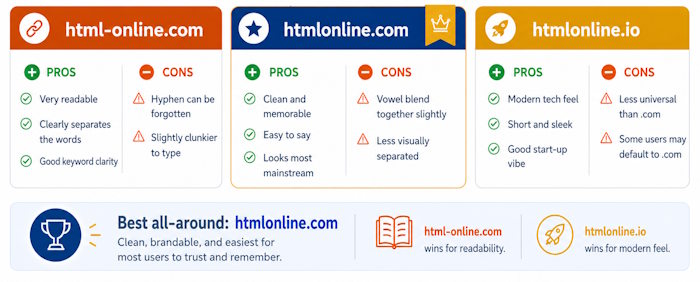
Story time: I had to pay $2,000 for a domain I could have registered much cheaper at the start. When I launched this site in 2015, I grabbed html-online.com with the hyphen, told myself it was fine, and moved on. The site grew and people started typing its name htmlonline.com without the hyphen, landing nowhere, and eventually someone else owned that cleaner version. Buying it later cost me two thousand dollars. The hyphen I shrugged at on day one turned into a four-figure invoice years later.
I’ve since registered 140+ domains for various projects, and that pattern repeats more than I’d like to admit: the decision feels trivial at registration and expensive in hindsight. So this isn’t another “keep it short and memorable” checklist. It’s what I’d tell a friend before they click register, based on the mistakes I actually paid for.
Clarity beats cleverness, every time
A good domain should survive being said out loud in a noisy room. If someone hears it once and can type it without asking “was that a one or the word one? Was there a dash?“, you’ve won. The domains that fail aren’t the boring ones; they’re the clever ones that need spelling out.

This is exactly where my hyphen mistake lives. Hyphens and numbers feel harmless when you’re staring at a registration form, but they double the friction every time someone shares your site verbally. “html dash online” is one extra instruction your audience has to remember and repeat correctly. They often won’t. Worse, the hyphen-free version of your name becomes a prime target for someone to register and either monetise or sell back to you – a practice close enough to typosquatting that it’s worth understanding before you build a brand on the awkward variant.
My rule now: pick the cleanest spelling you can get, and if you can’t get it, that’s a signal the name itself might be worth rethinking.
A practical checklist before you commit
Before registering anything, I run through the same short list. None of it is glamorous, but each item has saved me from a mistake at some point.
- 📱 Short and typo-proof. If you can’t type it correctly on a phone keyboard on the first try, neither can your visitors.
- 🌴 No “exotic” TLD. Don’t launch a website on a .net or other non-.com domain, unless you also own the .com version redirected to the other one.
- 🚫 No hyphens or numbers unless you genuinely have no choice – and if you don’t, see the $2,000 story above.
- 🎯 Reflects your purpose without boxing you in. A name that’s too narrow (“cheapblueshoes“) ages badly the moment you sell anything else.
- ⚖️ Doesn’t shadow an existing brand. A quick search now is cheaper than a cease-and-desist letter later.
- 📧 Sounds right spoken aloud and reads cleanly in an email address.
you@yourname.comis something you’ll write thousands of times.
This is the stage where you test availability and lock in your preferred name. A straightforward registrar makes this painless – I use providers like Easyname.at when I want to check options and register quickly without fighting the interface. Speed matters here, because good names disappear while you deliberate.
The checks most people skip but shouldn’t
Availability isn’t the same as “safe to buy.” Before I commit to a name, especially one with any history, I run four checks that take about five minutes combined:
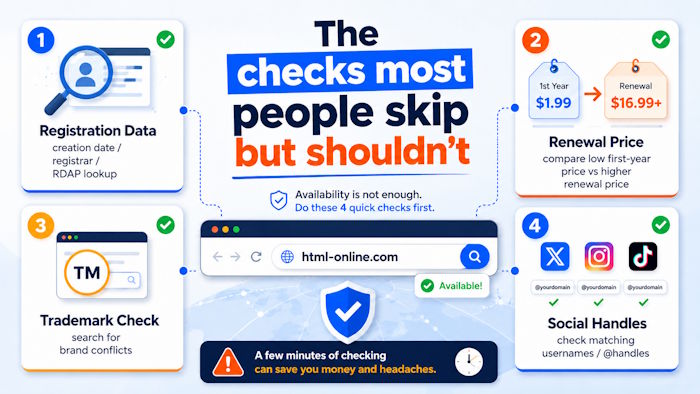
- Look up the registration data. ICANN’s Registration Data Lookup tool shows you a domain’s creation date and registrar. Note that as of early 2025, ICANN replaced the old WHOIS protocol with RDAP as the authoritative source, so the old
whois.icann.orgaddress now redirects here. The creation date alone tells you whether a name is genuinely fresh or has a past life. - Check the renewal price, not the first-year price. Plenty of names are cheap for year one and several times that on renewal. You’re not buying a domain for a year; you’re committing to it indefinitely.
- Do a trademark sanity check. A quick search of your country’s trademark register, plus a plain web search, catches the obvious collisions before you’ve printed business cards.
- Check the social handles. If the matching usernames are all taken by an unrelated company, your brand consistency is gone before you start.
Why keywords matter less than you think
There was a time when stuffing a domain with keywords helped rankings. That era is over. Search engines now weigh content quality, relevance, and user experience far above exact-match domain names, and an obviously keywod-engineered domain can read as low-trust to actual humans.

That doesn’t make keywords useless. If a relevant word fits naturally, it adds helpful context. But “natural” is the operative word. A name that aligns cleanly with your topic and your brand will outperform a search-engineered string over any meaningful timeframe, because people are the ones who bookmark, share, and remember it.
Choosing the right extension and registering the right ones
The extension does quiet work on trust and positioning. The classic options (.com, .net, .org) are still the safest defaults because they carry no explaining. Country extensions like .at, .de, or .uk signal local relevance, which is great for a regional business but can limit how international audiences perceive you. Newer extensions can absolutely work, but if a visitor doesn’t recognise the ending, that’s a half-second of hesitation before they click, and half-seconds add up.
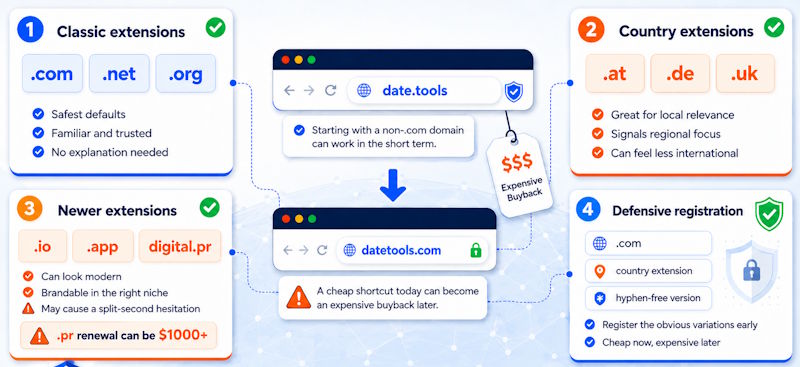
Here’s my second expensive lesson. Early on I launched a project on a .net because the .com was taken and .net was cheaper anyway. The site did well. And the better it did, the more I needed the .com – partly for trust, partly because traffic was leaking to whoever owned it. When I finally bought the .com, it cost dramatically more than registering it alongside the .net would have on day one.
So my advice is defensive registration: if a name matters to you, register the obvious variations early while they’re at standard price. The .com plus your country extension, and the hyphen-free spelling if you’re (foolishly, like past me) using a hyphen. Ten dollars each now is insurance against a four-figure buyback later.
Expired and aftermarket domains: opportunity and trap
You don’t only have to register brand-new names. Domains expire constantly, and an expired domain can come with real value – existing backlinks, established age, even residual traffic. But it can also carry a poisoned history: spam, a search penalty, or an association you don’t want attached to your brand.
This is where the Wayback Machine earns its keep. Before buying any domain with a past, I look it up there to see what it actually hosted. A name that was a clean small business is one thing; a name that was a link farm for gambling spam is a different proposition entirely, no matter how appealing the metrics look. Combine that history check with the registration-date lookup above, and you’ll avoid most of the landmines.
Domain value estimators: useful, but take them with salt
If you start exploring premium or aftermarket names, you’ll meet automated appraisal tools that spit out a confident dollar value for any domain. Treat these as a rough orientation, not gospel. After buying and selling enough names, I’ve learned the only real valuation is what a specific buyer will actually pay at a specific moment. I’ve seen “high-value” estimates that nobody would touch and unremarkable names that sold instantly because they were perfect for one particular business.
Use estimators to avoid wildly overpaying and to sanity-check a seller’s asking price, but don’t let a generated number convince you a domain is worth more or less than it is to you.
How the domain marketplace works
When the name you want is already registered, you’re not necessarily out of luck and you’re in the aftermarket. Many desirable domains are parked and for sale, listed on dedicated domain marketplaces or sold through auctions and brokers. This is exactly how I eventually acquired htmlonline.com: not by registering it, but by buying it from its owner at the price the market set.
If you go this route, a few things keep you sane. Decide your ceiling before you make contact, because attachment inflates budgets fast. Expect that a one-word or highly brandable name will command a premium that has nothing to do with what it cost to register. And remember that walking away is always an option. A slightly longer or differently-worded name you own outright often beats an expensive name you stretched to afford.
Plan your structure for growth
A domain rarely stays a single page. As sites grow they split into sections. A blog, a shop, documentation and how you organise that matters. You can use subfolders (yourname.com/shop, yourname.com/blog) or subdomains (editor.htmlonline.com, blog.htmlonline.com).
The practical difference: subfolders keep everything under one roof, which tends to consolidate your site’s authority and is the simpler default for most projects. Subdomains create cleaner separation, which suits genuinely distinct properties or teams, but search engines often treat them as somewhat separate sites, so you don’t automatically share all your built-up authority across them. Neither is universally “correct.” What matters most is choosing one approach and staying consistent, so your audience never experiences your site as a set of disconnected fragments.
Treat the domain as a long-term asset💎
The thread running through every story here is the same: a domain decision feels small at registration and compounds over time. The hyphen I ignored, the .com I skipped – both were cheap to get right early and expensive to fix later. A strong domain isn’t about being clever. It’s about being clear, trustworthy, and easy to return to, registered defensively enough that future-you isn’t paying four figures to undo a ten-dollar shortcut. Get that foundation right, and almost everything else you build online gets easier.